
The Quack, issue 371
The "every day is a good day" edition

Hello, friendo. It’s very nice to see you. I hope you had a wonderful week.
It’s been a hard one around here. We lost a dear friend. I’d like to tell you about him.
I’ve got a pot of tea all ready. You go grab us a couple clean mugs from the cupboard and meet me back here.
Let’s catch up.
No onions, please.
Erin worked the last couple of years with an older couple, helping them stay in their home as long as possible. When she met them, Don was 94 and Carol was 87. Over the course of time, we all became friends.
Carol died last summer. We lost Don this week.
Don’s lovely obituary will tell you a lot of things about him. He grew up in rural New Brunswick in the 1930s. He won a Beaverbrook scholarship to study for a year in London in 1955. He taught and later did education policy work in Ottawa, but his real mark would be left in Charlottetown where he was the founding president of Holland College.
A pretty impressive legacy. A pretty impressive man.
The obituary doesn’t mention how he felt about onions.
Don would eat just about anything, so long as it didn’t have an onion in it. If you offered to make him food or pick something up for him, he’d let you know: no onions, please. Every time he said it, had a little grin on his face, knowing it was a bit of a silly thing to dislike.
Erin once borrowed a recipe card from Carol so she could make his favourite “Spanish” meatloaf. We never could tell what made this absolutely middle-of-the-road dish Spanish. Carol wrote the recipe down in the 60s, and she was darned if she could remember. At some point in history—and I’m guessing it was early—she had crossed out the tablespoon of minced onion and pencilled in a teaspoon of onion salt.
Don thought about education every day. If you were speaking about just about anything, he’d listen respectfully and contribute to the conversation, but at some point, he’s lean back and say something like, “well, that brings to mind some thoughts I have on education.”
Don had many thoughts on education. It nagged at him that governments seem more interested in the operation of schools than the actual work of educating minds.
Don was bothered that no one else seemed bothered by this. He just couldn’t understand why people don’t want to talk about how we might do things differently. Education hasn’t changed much in 50 years. My kid’s high school experience looks largely the same as mine did in the 1990s, and mine looked largely the same as my parents in the 1960s.
Sometimes, Don worried there wasn’t discussion about change by design. He spent a lot of time thinking about who was in charge of stifling this conversation.
We finally decided there wasn’t a mastermind at work. People are pretty good at stifling their own conversation, if only to avoid being the person who has to follow through on whatever new ideas they came up with.
Don had a hard time with that. He grew up in a different era, when people worked together to build new things. This is a guy who was hired to start a brand new community college in February of 1969. They said he should shoot for a first intake of students in September of 1970. He shrugged and reset the dial. Classes started that fall.
Don talked a lot about how much the world changed after the second world war. He saw it fist on the farm in Black River Bridge.
Don’s dad owned a car. In Don’s earliest memories, the Model A was in storage in the barn, because it was too expensive to operate during the depression. When he was a little boy, he’d sit in the driver’s seat and pretend to drive.
When he was a kid before the war, the work of the farm was done by horses. Every summer, his dad would swim a team across the Black River to the little island where he owned a hay lot. They’d cut the hay and set it up into shocks and stacks, then swim the team back. In winter, they’d return to haul the hay back to the farm and load it into the haymow, using a horse-powered forklift system.
In the deep of winter, he and his brothers would work the hardwood ridge, cutting firewood for the next winter. They had to access the ridge by a lane on his uncle Jim’s place across the street. His mum packed sandwiches for the long day, and they’d warm themselves every few hours in the little shack in the woods, heated by a little wood stove.
Don’s mum was a gatherer. Nothing was more important than hosting supper on Sunday. You never knew who was coming, and everyone was always welcome. It was never fancy fare, but there was always enough for everyone.
I tried to bring Don a sugar doughnut whenever I went to visit him. I brought him one last weekend when he was in the emergency department waiting to be admitted.
“I don’t need a doughnut,” he said, as he did every time.
“Nobody needs a doughnut, Don,” I said in return, like I did every time.
He smiled and ate it with gusto.
Don’s mother made doughnuts. Not very often, mind. They were a sometimes-treat. If she was making them for the house, she’d fry them on the stove in the house. If she was making them for the community hall down the road (which his dad helped build—twice), she’d cook them in a kettle in the yard over an open fire. He remembers seeing dozens of donuts laid out in the sun as if they were a crop harvested from the farm.
Black River Bridge didn’t have power until Don was nearly 20. His family had a large radio in a wooden case which was powered by a series of batteries, including one borrowed from the car. They kept the system charged with a small windmill. In the evenings, they’d tune in to listen to American broadcasts from Gabriel Heatter. Don’s mum kept the radio by the open widow so neighbours who weren’t so fortunate could sit in the yard and listen to the news of the day.
Don remembers the day the power finally arrived. Their farm had been wired for it in anticipation of the day they flipped the switch. He was walking home from a day of teaching at the consolidated school and spotted the light of the bulb hanging over the porch. He rushed to the linen closet to pull down an old electric iron. His mum had brought it back from the states, where she’d worked a young woman and met Don’s dad. The iron had laid idle for more than 20 years, but when he plugged it in, it slowly came to life.
Don was generous with his stories, and Erin and I were sponges to soak them up. He struggled with his memory in the last year of his life, and that bothered him. We always found a surefire way to ease his mind was to lead the discussion to Black River.
This summer, we’ll drive to Black River for an internment ceremony in the cemetery behind the United Church about a mile up the road from his childhood home. Before Don was born, when it was still Presbyterian, it had been his family’s church. When most of the congregation voted to join the United Church in 1925, his family and others built a smaller church just up the road. Don would be the first baby blessed at the new church.
The church split would cause some tension through the years, but both congregations shared the old cemetery. Don noted some politics are best left to the living.
I’m going to miss my friend a lot. Making friends as an adult is pretty hard, but this was easy. We drank coffee. We told each other stories. He always thanked Erin and I for spending time with him, but the truth was, we were the lucky ones.
“How are you doing today, Don?” I said every time we met.
“Every day is a good day,” he said, every time.
Every time.
Portraits of a Dovecote
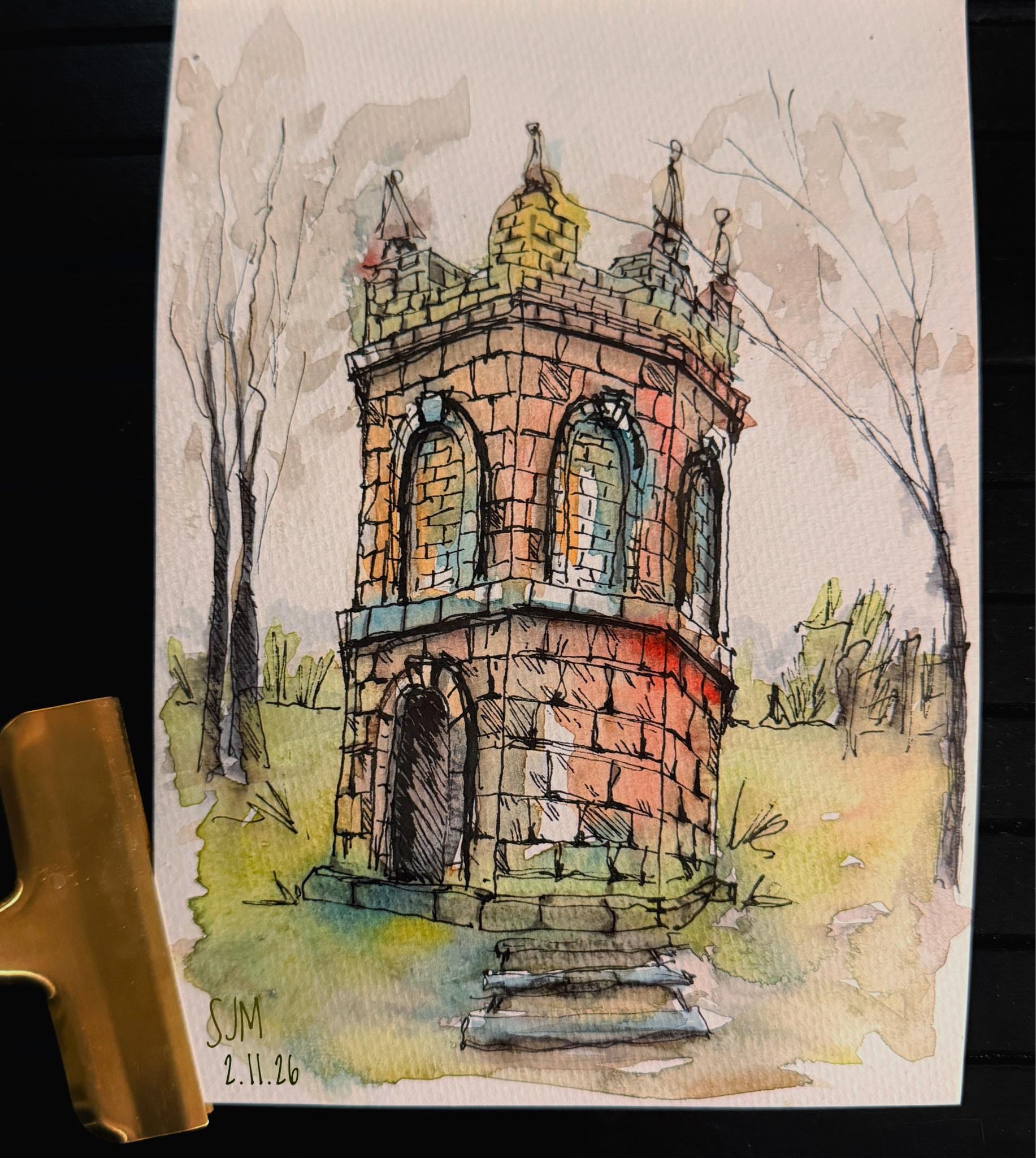
Neighbour and pal of The Quack Sam Murphy was inspired by the photo I shared last week from Erin’s trip to Scotland. This is the old stone dovecote at the estate where Erin took her courses. Isn’t that amazing? Check out more of Sam’s wonderful work here.
Thanks for hanging out with me another Sunday.
Over in Dunnock Bay, Mindy, the new librarian, is getting to know some of the regulars at her new posting. Is it possible to call someone a chess prodigy if that person happens to be an 85-year-old woman? Read Muriel the GOAT, and don’t forget to like and share. It really really really is making a difference.
Have a great week.
I like that ….Every day is a good day ! …enjoyed both reads & look forward to next week!